
TL;DR
- Unit Economics, Not Hype: Choosing between serverless (pay-per-token) and dedicated (pay-per-hour) AI infrastructure is a pure math problem; picking the wrong setup for your traffic silently drains your runway.
- Know Your Break-Even Point (N∗): Calculate the exact daily request volume where a fixed-cost dedicated GPU becomes cheaper than climbing serverless API bills.
- Latency Overrides Cost: For real-time voice or conversational AI, strict Time To First Token (TTFT) requirements make warm, dedicated instances mandatory to avoid dead air, regardless of your traffic volume.
- Mind the Idle Trap: Dedicated infrastructure only saves money if your effective GPU utilization is high; paying premium hourly rates for dormant GPUs overnight will quickly erase your savings.
- Start Shared, Graduate Dedicated: Launch on serverless to validate your model and absorb spiky traffic, then migrate to a dedicated cluster once you cross your break-even threshold or require strict data isolation.
For AI startups and enterprise tech teams across Gurugram and the broader Indian tech landscape, deploying a Large Language Model (LLM) into production is no longer just a research experiment; it is a core business operation. But the moment you move your AI application from a local sandbox to live users, you inevitably crash into a critical infrastructure roadblock: how do you structure your compute costs?
You are forced to choose between two paths: pay per token on a highly flexible shared/serverless endpoint, or commit to paying per GPU-hour for a dedicated inference instance. Both architectural choices are completely legitimate. However, misaligning this decision with your actual traffic pattern is one of the fastest ways to quietly burn through your operational runway.
When Indian engineering teams get this wrong, the financial drain is silent but severe. You either over-provision too early, sinking valuable rupees into idle GPU-hours while your servers sit dormant waiting for traffic, or you stick with the comfort of serverless way too long. In the latter scenario, your traffic scales up, and you are suddenly hit with a massive, creeping monthly bill that far exceeds what a dedicated H100 cluster would have cost you months ago. This isn't just about technical preference; it's about survival math.
Beyond the Hype: The Math of Serverless vs Dedicated LLM Inference
Let’s get one thing straight immediately: this isn't another generic "serverless is always cheaper" or "dedicated hardware is always faster" thought-leadership post. In India's pragmatic, cost-conscious tech hubs like Gurugram and Bengaluru, relying on absolute statements is a dangerous way to burn through your operational capital. Instead, this is about the underlying unit economics, the hard numbers, and the definitive decision tree you need to navigate AI deployment effectively.
The Core AI Infrastructure Decision Framework
When engineering teams scale their generative AI applications, they often get distracted by marketing claims and vanity benchmarks. In reality, whether you are hosting locally for Indian consumers or routing globally, only four critical variables actually determine your correct deployment architecture. Everything else is simply noise.
Navigating Real-World Deployment Trade-Offs
In a perfect scenario, your technical requirements would align neatly into a single column. However, almost every real-world LLM deployment in the Indian market is a tug-of-war between two of these variables pulling your architecture in opposite directions.
Take, for example, a local startup building a real-time AI voice agent for customer support.
- The Conflict: The application is highly sensitive to Time To First Token (TTFT); even a one-second cold start on a serverless endpoint results in audible dead air that ruins the conversation.
- The Reality: Strict latency requirements aggressively push the architecture toward dedicated hardware to keep the model warm in VRAM, while low initial user volume and cost sensitivity pull it back toward serverless.
This exact friction- needing instant responses without having the baseline traffic to easily justify a 24/7 dedicated GPU- is the scenario that actually requires the hard mathematical breakdown below, rather than just high-level strategic frameworks.
The Math That Matters: Calculating Your LLM Break-Even Point
Strip away the aggressive cloud marketing, and the infrastructure decision for AI engineering teams in India ultimately boils down to pure unit economics. Regardless of the provider, the two pricing models reduce to these fundamental equations:
Serverless Inference: Linear Cost Scaling
On a shared endpoint, your AI infrastructure cost scales strictly linearly with your application's usage. You are paying for the exact compute consumed by your generated tokens. Daily Cost = (Cost per Request) × (Requests per Day)
Dedicated Inference: Fixed Hourly Compute
With a dedicated setup, your daily cost is fixed regardless of your actual token throughput. You are renting the GPU instance (such as an NVIDIA H100 or A100) by the hour, not by the output. Daily Cost = (GPU Hourly Rate) × (Hours the Endpoint is Live)
Finding N*: The Break-Even Formula
The critical metric for any scaling AI platform, from early-stage Gurugram startups to enterprise teams, is the break-even point. This is the exact number of daily requests where a dedicated GPU stops being a luxury and becomes the cheaper option.
N = (GPU Hourly Rate × Hours/Day Live) / (Cost per Request on Serverless)*
Below the N* threshold, serverless inference wins. Above N*, dedicated infrastructure wins, and from that point onward, the cost gap widens linearly as your user traffic grows. Your dedicated costs remain completely flat, while your serverless bills will continue to climb skyward.
The Two Traps DevOps Teams Consistently Fall Into
When running these break-even calculations to plan their runway, engineering teams frequently make two highly expensive assumptions:
1. "Hours/Day Live" is not always 24 hours. Many teams mistakenly calculate their dedicated costs assuming the hardware must run continuously, 24/7. However, if your dedicated endpoint can scale to zero during off-peak hours, a feature supported by modern AI infrastructure platforms like Simplismart, your effective daily GPU-hours drop significantly. This shifts the N* break-even point much lower, making dedicated GPUs financially attractive much sooner than anticipated.
(Note: If your endpoint must stay warm 24/7 to prevent latency issues, which we will cover in the cold-starts section, you are locked into paying the full 24-hour rate, regardless of overnight traffic drops).
2. Serverless cost per request is never flat across model sizes. It is a common mistake to assume serverless economics remain stable as you upgrade or change your models. A compact 7B parameter model and a massive 700B-parameter Mixture-of-Experts (MoE) model have wildly different per-token economics. Serverless API pricing strictly reflects the underlying compute the provider is burning per token. Therefore, larger active-parameter models will always cost substantially more per million tokens. The heavier your model, the faster you will hit that N* break-even point where migrating to dedicated infrastructure becomes mandatory.
Cold Starts: The Variable That Overrides Inference Cost Math Entirely
Sometimes the break-even calculations discussed above simply don't matter. Why? Because strict latency requirements can eliminate one architectural option outright before you even run the numbers.
When Latency Eliminates Serverless
For AI developers in Gurugram building voice AI and real-time customer service agents, Time To First Token (TTFT) is a critical metric. A cold start of even 1–2 seconds on a serverless endpoint- the time it takes the platform to spin up a worker, load massive model weights into VRAM, and warm the KV cache- results in audible dead air in a human conversation.
No amount of rupees saved on a serverless bill can offset a broken user experience. In these TTFT-sensitive use cases, a dedicated endpoint is mandatory, even if your daily request volume wouldn't justify the cost on paper. You aren't just buying raw compute; you are paying to keep a warm model sitting in VRAM, ready to fire instantly.
Where Serverless Always Wins
Batch document processing is the mirror opposite. Nobody watches a progress bar tick per-document in real-time. If a cold start gets absorbed into a 10-minute overnight batch job, it is completely invisible to the user. This is exactly where serverless inference wins every time, regardless of the scale. Your infrastructure scales to zero during idle periods, spins up parallel workers when the batch lands, and you pay exclusively for the compute consumed, and absolutely nothing between jobs.
The Practical Latency Rule: If your P99 latency budget is smaller than a standard cold-start window, dedicated infrastructure isn't optional; it’s the only correct answer. The conversation immediately shifts from whether you need dedicated compute to which dedicated GPU to provision.
GPU Utilization Curves: Where Dedicated Infrastructure Quietly Bleeds Capital
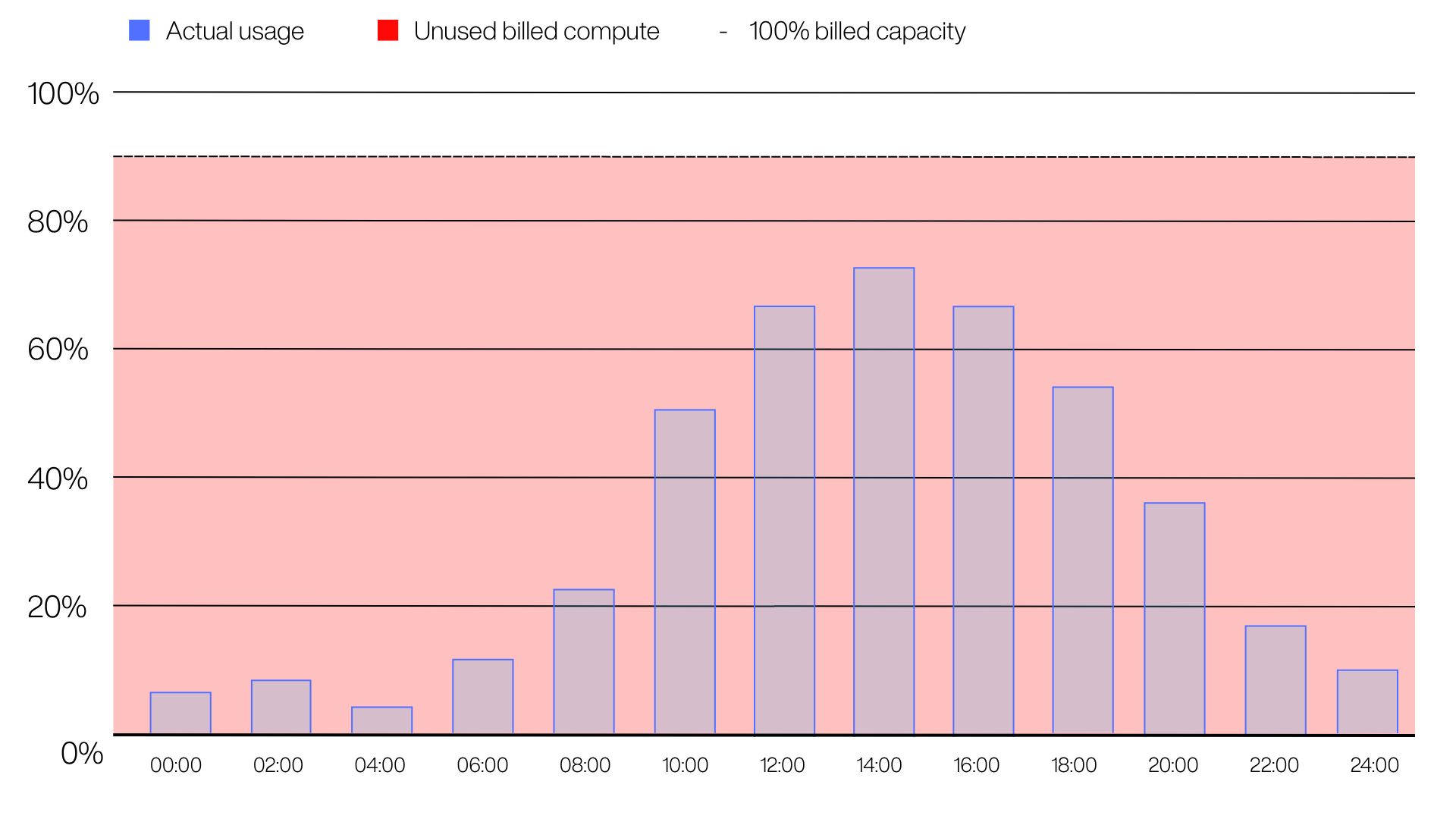
This is the hidden trap where dedicated setups quietly lose money. A dedicated endpoint bills you for the GPU-hour whether it is aggressively serving 100 requests per second or sitting at a meager 8% load overnight.
The Peak Capacity Trap
Indian tech teams frequently fall into the trap of over-provisioning dedicated capacity for peak traffic, for instance, to handle high activity during standard IST business hours, and then pay the full, premium hourly rate through every overnight trough.
Tracking Effective GPU Utilization
The single financial metric worth tracking here is effective utilization: the actual GPU-hours doing inference work divided by the total GPU-hours billed.
If your dedicated endpoint runs at a 30% average utilization, you are essentially paying for roughly 3.3x the compute you are actually using. At that low utilization rate, serverless API pricing, which inherently has zero idle cost because you are never billed for a quiet GPU, is almost certainly cheaper, even at request volumes that initially "looked like" they should favor dedicated hardware on paper.
Dedicated infrastructure mathematically makes sense only when your utilization stays consistently high (sustained traffic with minimal idle windows), or when the motivation isn't cost at all. If you are solving for a strict latency guarantee, absolute data isolation, or running a proprietary fine-tuned model that simply isn't available on shared tiers, then dedicated is your definitive path forward.
A Worked Example: Processing 50K Requests/Day on GLM-5.2
To see how this infrastructure math actually plays out for an Indian engineering team, let's stress-test the framework using GLM-5.2. Released under an MIT license in June 2026, GLM-5.2 is genuinely massive: a Mixture-of-Experts (MoE) model with roughly 744 billion total parameters, activating about 40 billion per token.
Unsloth
This size fundamentally changes the dedicated side of the calculation. Even though only ~40B parameters are active per token, all the expert weights must sit in VRAM. At BF16 precision, you are looking at roughly 1,500GB to 1,600GB of VRAM, which translates in practice to a massive cluster (up to 16 GPUs) before you apply FP8 quantization to cut the footprint down.
Unsloth+ 1
Here is how the decision framework applies to a 50K request/day volume, using typical H100 dedicated pricing as a baseline anchor (for context, providers like Together AI price a single dedicated H100 at roughly $6.49 per hour).
The Serverless Calculation
Cost per request = (avg tokens/request) × (cost per million tokens) ÷ 1,000,000. At 50K requests per day, your cost scales perfectly linearly. You pay absolutely zero idle costs. However, because GLM-5.2 has a 40B active-parameter footprint, the per-token serverless pricing sits meaningfully higher than what a small, dense 7B model would cost.
The Dedicated Calculation
Because deploying GLM-5.2 requires a multi-GPU cluster (typically 8–16 GPUs depending on your precision choice), the relevant comparison isn't a single GPU-hour. Cost = (Full 8x/16x cluster's hourly rate) × (Hours live per day)
The Honest Answer at 50K Requests
At 50K requests a day, do not eyeball the math; run your exact numbers. GLM-5.2's dedicated cluster cost depends entirely on your GPU count, which depends directly on your quantization choice (moving from BF16 to FP8 roughly halves your VRAM requirement and, therefore, your hardware costs). Furthermore, dedicated enterprise pricing on platforms like Simplismart is typically quote-based per custom configuration rather than a flat, published rate.
What the framework tells you directionally is this: at 50K requests per day, you are in the gray zone. The cheaper option hinges entirely on your average tokens per request and how bursty your Indian user traffic actually is. This is the exact volume where your DevOps team should be plugging custom quotes into the N* break-even formula.
(Author's Note: Before locking in a specific INR vs USD break-even figure in your final business case, always pull the live dedicated $/GPU-hour and Shared Endpoint $/1M-token rates directly from your provider's pricing page to ensure absolute accuracy).
The Simplismart Path: Don't Just Pick Once, Graduate
The deployment framework above assumes you are making a static, permanent choice. But fast-growing AI startups in Gurugram don't need a static choice; they need a fluid migration path.
Platforms like Simplismart run both models side-by-side specifically to solve this problem. Whether you are running LLM chat inference, Whisper transcription, or Flux image generation, you can provision them as either shared serverless endpoints or dedicated clusters. When you eventually move to dedicated, you gain exclusive infrastructure, total isolation from noisy shared workloads, and full support for proprietary fine-tuned models.
The Practical AI Scaling Sequence
If you are charting an infrastructure roadmap, here is the proven sequencing strategy:
- Start on the Serverless Shared Endpoint. Validate that the model actually solves your business use case. Gather real-world user traffic data and let the serverless model absorb the unpredictability while your volume is still low, bursty, and unpredictable.
- Watch your N break-even number, not your gut.* Once your measured daily requests approach the break-even threshold calculated for your specific token counts and GPU requirements, the financial argument for dedicated infrastructure stops being theoretical.
- Graduate early if latency or isolation forces the issue. If you are building voice AI, agentic workflows, or anything highly TTFT-sensitive, do not wait for the cost break-even point. Move your application to a dedicated endpoint as soon as the latency requirement becomes real, and treat the cost math as a secondary optimization (like right-sizing your GPU count or applying quantization) rather than the gatekeeper to a working product.
Final Verdict: Choosing the Right LLM Architecture
Picking between serverless APIs and dedicated GPU clusters is never a binary, permanent decision; it is a continuous evolution dictated by your application's unit economics, latency constraints, and user growth.
Misjudging the transition quietly burns capital, but adhering to the math keeps your AI infrastructure lean and scalable:
- Stick with Serverless when: Your traffic is bursty or in its early validation phase, your batch workloads tolerate cold starts, and your request volume sits comfortably below the N* break-even threshold.
- Transition to Dedicated when: Your daily request count consistently crosses N*, your average effective GPU utilization stays above 50–60%, or sub-second Time To First Token (TTFT) is a non-negotiable product requirement for real-time voice and agentic systems.
Key Takeaway Matrix
Take Control of Your Compute Costs
Do not let your inference bills outpace your business growth. Calculate your N* break-even point with your actual token loads, monitor your effective GPU utilization curves, and migrate to dedicated infrastructure as soon as your scale demands it.
Frequently Asked Questions (FAQ)
What is the fundamental difference between serverless and dedicated LLM inference?
Serverless inference operates on shared infrastructure where you pay strictly per token or per API request processed, and compute automatically scales to zero when idle. Dedicated inference allocates reserved, isolated GPU hardware (such as NVIDIA A100 or H100 instances) exclusively to your workload, billed at a fixed hourly rate regardless of request volume.
How do you calculate the break-even point (N*) between serverless and dedicated endpoints?
The break-even point (N*) is calculated using the formula:
N*=GPUHourlyRateHoursEndpointisLiveperDayCostperRequestonServerless
If your daily request volume is below N*, serverless is more economical; once sustained daily requests exceed N*, dedicated compute becomes cheaper per unit.
Why do cold starts make serverless unsuitable for real-time voice and conversational AI?
A cold start occurs when a serverless system spins up a new worker container, loads model weights into VRAM, and warms the KV cache, taking 1 to 5+ seconds. In voice AI and conversational agents where sub-second Time To First Token (TTFT) is required, this latency creates audible dead air, degrading the user experience and making warm dedicated instances necessary.
What is effective GPU utilization and how does it cause financial waste?
Effective utilization is the ratio of active inference time to total billed GPU-hours. Because dedicated instances bill continuously, running at 30% average utilization means paying for roughly 3.3x the compute actually consumed. At low utilization, paying a fixed hourly rate for idle capacity often costs more than pay-as-you-go serverless pricing.
Can dedicated GPU endpoints scale to zero during off-peak hours?
Yes. Modern AI inference platforms support scheduled or automated scale-to-zero configurations for dedicated endpoints during off-peak windows (such as overnight hours). This reduces the effective "hours live per day" variable in the break-even formula, lowering N* it and making dedicated hardware cost-effective at lower total volumes.
How does model architecture (e.g., 7B dense vs. 700B MoE) affect deployment choice?
Model size impacts the two models differently:
- Serverless: Providers set per-token pricing based on active parameter compute per token.
- Dedicated: Hardware cost is dictated by total parameter memory footprint. A Mixture-of-Experts (MoE) model like GLM-5.2 requires all weights to reside in VRAM (requiring multi-GPU clusters), making dedicated entry costs much higher compared to hosting a single-GPU 7B or 8B model.
What is Time To First Token (TTFT) and why does it override cost calculations?
Time To First Token (TTFT) measures the latency between sending a prompt and receiving the initial output token. When an application's P99 latency SLA is stricter than a typical serverless cold-start or queuing window, infrastructure choice is dictated by performance rather than cost, necessitating dedicated instances to keep models pre-loaded in memory.
Does dedicated inference offer data privacy and compliance advantages?
Yes. Dedicated endpoints provide single-tenant isolation, ensuring that model weights, prompt context, and output tokens never transit shared hardware queues or multi-tenant memory buffers. This isolation is critical for enterprise applications subject to strict data governance, SOC 2 compliance, and local regulatory requirements.
How does quantization impact dedicated GPU cluster sizing?
Quantization (such as converting weights from BF16 to FP8 or INT4) reduces the VRAM required to hold model parameters by 50% or more. For large models, this reduction allows engineering teams to cut the required GPU count in half (e.g., downsizing from an 8-GPU cluster to a 4-GPU cluster), drastically lowering the hourly dedicated rate and shifting the break-even point in favor of dedicated deployment.
What is the recommended strategy for migrating from serverless to dedicated infrastructure?
The standard deployment roadmap follows a three-stage sequence:
- Validate on Serverless: Launch on shared endpoints to prototype, absorb bursty demand, and collect real traffic metrics without idle overhead.
- Track the N* Threshold: Monitor empirical daily token volume and calculate effective GPU utilization.
- Graduate to Dedicated: Transition to dedicated clusters once sustained traffic crosses N* or when strict TTFT, custom fine-tuned weights, or single-tenant isolation become mandatory.
Ready to Optimize Your LLM Infrastructure Economics?
Stop guessing whether serverless APIs or dedicated GPU clusters make sense for your current user growth. Whether you are scaling an early-stage MVP or fine-tuning massive models for enterprise production, Simplismart gives you the flexibility to transition seamlessly between high-density serverless endpoints and dedicated private clusters.
- Deploy Your Way: Choose pay-as-you-go serverless to absorb spiky traffic with zero idle costs, or spin up dedicated clusters for complete hardware isolation.
- Eliminate Latency Bottlenecks: Access pre-warmed pools and enterprise-grade performance built for real-time voice, agents, and low-TTFT workloads.
- Control Unit Economics: Optimize your infrastructure costs as you scale with robust multi-model management and transparent resource scaling.
Explore Simplismart Infrastructure & Calculate Your Scale Today