
TL;DR
- Model Overview: GLM-5.2 is a 753B parameter MoE model with an MIT license, offering a genuine choice between Z.ai's managed API and self-hosting.
- Affordable API: Priced aggressively at $1.40/1M input and $4.40/1M output tokens, the API significantly undercuts competitors—especially with prompt caching reducing input costs by ~81%.
- Steep Self-Hosting Costs: You must fit all 753B parameters in memory, requiring a massive 8xH200 GPU node that costs ~$15,000 to ~$23,000/month in raw compute alone.
- The Breakeven Point: The API is drastically cheaper for standard volumes (100K to 10M tokens/day). Self-hosting only becomes cost-effective at a massive scale of 290M to 350M tokens per day.
- When to Self-Host: Stick to the API for 99% of use cases. Only take on self-hosting if you exceed the 300M token threshold, require custom fine-tuning, or have strict data residency mandates.
Every team that adopts a new large language model eventually runs into the same fork in the road: pay per token through a managed API, or take on the operational weight of running the model yourself. For most frontier, closed-weight models, this isn't really a decision; you use the API because there's no alternative. GLM-5.2 changes that calculus. Released by Z.ai (the international brand of Beijing-based Zhipu AI) on June 16, 2026, GLM-5.2 ships under a fully permissive MIT license with open weights, which means self-hosting isn't a hypothetical workaround; it's a first-class, legally unencumbered option from day one.
That puts GLM-5.2 in a small, interesting category: a frontier-class model, competitive with Claude Opus 4.8, GPT-5.5, and Gemini 3.1 Pro on benchmarks, that you can either rent by the token or run entirely on your own infrastructure. The question this piece works through in detail is a practical one: at realistic production volumes, 100,000 tokens a day, 1 million tokens a day, and 10 million tokens a day, which option actually costs less, and by how much?
This isn't a benchmark review or a "why GLM-5.2 is good" piece. It's a cost model, built from Z.ai's officially published API pricing and cross-referenced GPU market rates, walked through step by step so you can substitute your own workload assumptions and get a real answer for your own usage pattern.
GLM-5.2 Specs, Architecture, and Features Explained
Before the cost math means anything, it helps to understand what's actually running under the hood, because the architecture is the entire reason this model is cheap enough to make the self-hosting question interesting in the first place.
Architecture and Context Window
GLM-5.2 is a Mixture-of-Experts (MoE) model with 753 billion total parameters, but only about 40 billion of those activate on any given forward pass, roughly 5.4% activation. This is the standard MoE trick: you get the representational capacity of a much larger dense model, but the compute cost per token tracks closer to a 40B-parameter model than a 753B one. It's the single biggest reason GLM-5.2's official API pricing looks the way it does, and it's also the reason self-hosting is even feasible on "only" an 8-GPU node rather than requiring a small data centre.
The model carries forward the GLM-5 architecture lineage and adds a genuinely usable 1-million-token input context window alongside up to 128K–131K tokens of output per response. It also introduces an attention optimisation Z.ai calls IndexShare, which reuses the same indexing component across every four sparse-attention layers instead of recomputing it at every layer, cutting per-token compute by roughly 2.9x at the full 1M-context length. That matters operationally: without it, long-context inference at this scale would be considerably more expensive to serve, whether you're paying Z.ai for it or paying for it in GPU-hours yourself.
Important Details for Self-Hosting
Two other details matter for anyone thinking about self-hosting specifically. First, GLM-5.2 is text-only, no native image or PDF-as-pixels input. If your workload needs multimodal input, you're looking at pairing it with a separate vision model regardless of hosting choice, and that's outside the scope of this cost comparison. Second, it supports configurable "thinking" effort levels, High and Max, which trade latency and token spend for reasoning depth. Higher effort levels burn more output tokens per response, which directly affects your bill on the managed API and your throughput ceiling if you self-host. The cost tables below assume a blended, moderate-effort workload; if your use case leans heavily on Max-effort reasoning for every call, scale the output-token assumptions up accordingly.
Official Managed API Pricing
This is the part of the analysis grounded entirely in a primary source. Z.ai's own developer platform lists the following pay-per-token rates for GLM-5.2, and this pricing has been independently corroborated by Artificial Analysis, Together AI's model listing, and multiple API gateway trackers that pull directly from the official rate card:
A few things are worth sitting with here:
- Unchanged Pricing with Higher Efficiency: This pricing is unchanged from GLM-5.1. Z.ai shipped a meaningfully more capable model (5x the context window of its predecessor, plus the IndexShare efficiency gains) without raising the sticker price. That's a signal the underlying serving cost per token has genuinely come down, not just that Z.ai is subsidising adoption temporarily.
- The Impact of Prompt Caching: The cached-input rate is easy to overlook but is often the single biggest lever available to reduce your bill, especially for agentic or RAG-style workloads that repeatedly re-send large, mostly-static context (a system prompt, a codebase snapshot, a retrieved document set). At $0.26 versus $1.40 per million tokens, a cache hit costs about 18.6% of a cache miss.
- Competitive Benchmark Pricing: This is a genuinely useful reference point for judging whether $1.40/$4.40 is actually cheap: GLM-5.2's input pricing runs roughly 3.6x cheaper than Claude Opus 4.8 or GPT-5.5, and its output pricing runs roughly 5.7x to 6.8x cheaper than those same models. Put simply: at the API level, GLM-5.2 is priced to compete on cost, not just capability.
Setting Up the Cost Model: Assumptions
No cost analysis is useful without stating its assumptions plainly, because the "right" numbers for your team will differ based on your actual token mix. Here's what this analysis uses, and why:
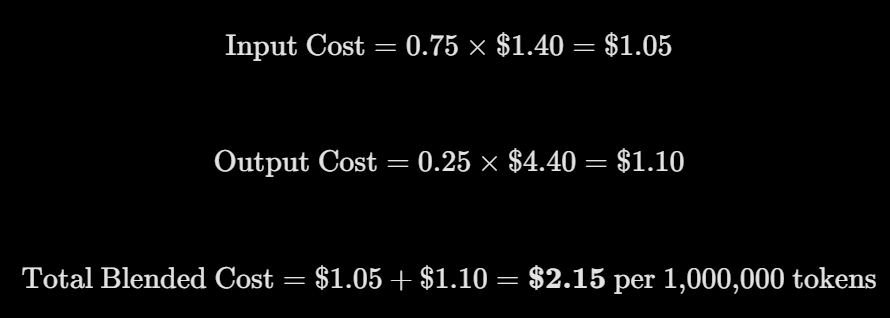
- Token split (75% input, 25% output): GLM-5.2 is explicitly positioned for long-horizon coding and agentic workflows, reading large amounts of context (codebases, documentation, conversation history, tool outputs) and producing comparatively shorter, targeted completions. A 3:1 input-to-output ratio is a reasonable default for that profile. If your workload is closer to a chat interface with short prompts and long generated answers, flip this ratio and redo the math; the mechanics below still apply.
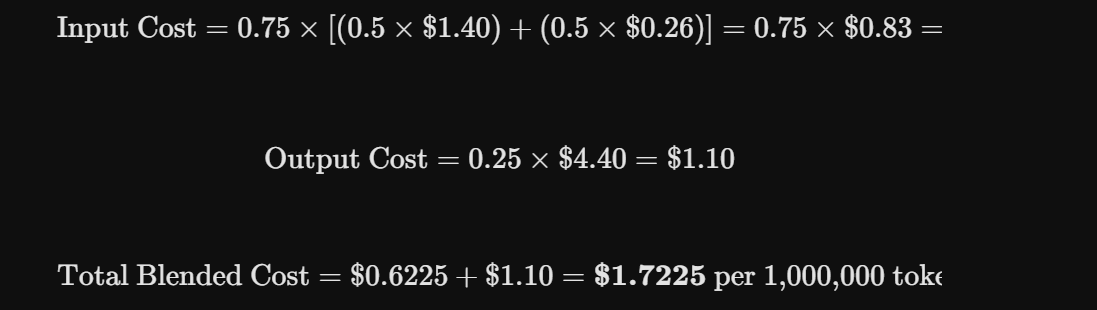
- Two caching scenarios (0% and 50% cache hit rate on input tokens): A 0% scenario represents a cold-start or highly variable-context workload where nothing repeats between calls. A 50% cache-hit scenario represents a more typical agentic loop, where a large chunk of context (system instructions, a pinned document, a stable codebase snapshot) persists across many consecutive calls while only a smaller "delta" portion changes each turn. Real production agent loops often exceed 50% cache hit rates once optimised, so treat this as a conservative middle estimate rather than a ceiling.
- No fine-tuning or embedding costs included: This is a pure inference cost comparison, API call cost versus infrastructure cost to run inference. Training, fine-tuning, and embedding-generation costs are separate line items not modelled here.
- 24/7 uptime assumed for the self-hosted comparison: This is the conservative (harshest) framing for self-hosting, because it assumes you're paying for infrastructure around the clock rather than spinning it up only when needed, which is realistic for anyone who needs low-latency, always-available inference rather than batch processing.
Blended Cost Per Million Tokens
Using the 75/25 split against official rates:
Scenario 1: No Caching (0% Cache Hit Rate)
Scenario 2: With 50% Cache Hit Rate on Input Tokens
Managed API Cost at Each Volume Tier
Tier 1: 100,000 Tokens/Day
This is a modest volume, think a small internal tool, a handful of active users, or a lightly-used agent running a limited number of tasks per day.
At this volume, the cost is trivial in absolute terms, under $10/month regardless of caching strategy. This tier is worth mentioning mainly as a baseline: at 100K tokens/day, the idea of self-hosting shouldn't even enter the conversation on cost grounds, because the fixed infrastructure cost of any dedicated GPU node dwarfs this bill by two to three orders of magnitude, a point the self-hosting section below quantifies directly.
Tier 2: 1,000,000 Tokens/Day
This represents a genuinely active production workload, a customer-facing feature with real usage, a coding assistant used regularly by a development team, or an agent pipeline running continuously throughout the workday.
Even at this tier, a million tokens every single day, sustained, the managed API bill sits well under $100/month. For most engineering teams, this is a rounding error relative to compute, staffing, or even the cost of a single cloud VM running a supporting service.
Tier 3: 10,000,000 Tokens/Day
This is a serious production volume, the kind of throughput you'd see from a company-wide coding assistant, a high-traffic customer support agent, or a batch-processing pipeline running continuously against a large document corpus.
Self-Hosting: What It Actually Requires
Here's an important methodological note before diving in: Z.ai publishes model specifications and API pricing, but, like essentially every model provider, it doesn't sell or price GPU infrastructure. Self-hosting cost estimates below are therefore built from current GPU cloud rental market data and third-party deployment guides (vLLM's official recipe documentation, NVIDIA's NIM reference, and GPU cloud pricing aggregators), not from an "official" Z.ai hosting price sheet, because no such thing exists. This is worth flagging clearly rather than blending it seamlessly with the officially-sourced API numbers above.
Hardware Requirements
The critical fact about MoE models that trips people up: even though only ~40 billion of GLM-5.2's 753 billion parameters activate on any given forward pass, all 753 billion parameters still have to reside in GPU memory, because the routing mechanism can select any expert on any token, and you can't predict in advance which ones. The "active parameter" number tells you about compute cost per token; it tells you almost nothing about the memory footprint you need to provision.
The practical, documented default deployment for GLM-5.2 is the FP8 checkpoint, which fits on a single 8-GPU node using either H200 or H20 GPUs (each with 141GB of HBM3e memory). Reaching the model's full 1-million-token context window pushes memory requirements further, because KV-cache size scales with context length; at a full 1M-token context, the recommended configuration steps up to 8xB200 GPUs (180GB each), which is the newer, more expensive Blackwell-generation hardware. An NVIDIA-produced NVFP4 quantised variant compresses the checkpoint to roughly 465GB, fitting more comfortably on Blackwell hardware, but this is a quantised variant with corresponding quality tradeoffs, not the full-precision model.
For this cost analysis, we'll use the more commonly deployed 8xH200 configuration as the baseline, since it's the documented practical default and the one most teams evaluating self-hosting will actually price out first.
GPU Rental Cost
Cloud GPU pricing for H200S varies enormously by provider, region, and commitment model. Aggregated market data puts on-demand H200 pricing across tracked providers in a range of roughly $1.45 to $13.78 per GPU-hour, with a market median around $3.95 per GPU-hour as of mid-2026. A separate, broader index puts the median closer to $4.11/GPU-hour, with a low end around $2.30–$2.60/hour for no-minimum, no-commitment dedicated access from smaller specialised providers.
Using the market median (~$3.95/GPU-hour) for an 8-GPU node:
Using the market median (~$3.95/GPU-hour) for an 8-GPU node:
- Hourly: 8 GPUs × $3.95 = $31.60/hour
- Daily: $31.60 × 24 hours = $758.40/day
- Monthly: $758.40 × 30 days = $22,752/month
Using the cheaper, no-minimum end of the market (~$2.60/GPU-hour):
- Hourly: 8 GPUs × $2.60 = $20.80/hour
- Daily: $20.80 × 24 hours = $499.20/day
- Monthly: $499.20 × 30 days = $14,976/month
These figures cover GPU compute only. They don't include the engineering time to deploy and maintain a vLLM or SGLang serving stack, monitoring, load balancing, storage for the model weights (the full checkpoint runs well over a terabyte in BF16, somewhat less in FP8), networking, or the operational overhead of handling GPU failures, driver updates, and scaling logic. A realistic fully-loaded self-hosting cost would run meaningfully higher than the raw GPU rental figure, but even using just the raw compute number, the comparison below is instructive.
Self-Hosting Cost is Fixed, Not Variable
Here's the structural difference that matters most: this GPU rental cost doesn't change based on how many tokens you actually process, as long as you're within the node's serving capacity. Whether you send it 100,000 tokens a day or 10 million, you're paying for the same rented hardware, sitting there, ready to serve requests.
The Breakeven Point
The interesting question is: at what daily token volume does the fixed cost of self-hosting become cheaper than the linearly-scaling cost of the managed API?
Using the mid-market self-hosting cost (~$758/day) against the no-caching blended API rate ($2.15 per million tokens):

Using the cheaper self-hosting estimate (~$499/day) against the cached-API rate ($1.72 per million tokens):

So depending on which end of the GPU pricing range and which caching assumption you use, the breakeven sits somewhere in the neighbourhood of 290 to 350 million tokens per day. Compare that to the three tiers examined in this piece: 100K, 1M, and 10M tokens/day. At 10 million tokens a day, the top end of our range, you're operating at roughly 3% of the volume needed to make raw self-hosting economics work out in your favour. Even generously rounding, you'd need to be processing somewhere between 30 and 50 times more traffic than our largest tier before a dedicated node starts paying for itself on cost alone.
An Important Caveat on This Number
This breakeven calculation assumes single-stream throughput scaled naively against a flat daily rental cost; it does not model production-grade continuous batching, where a self-hosted server handles many concurrent requests simultaneously and drives effective per-token cost down substantially. GLM-5.2 generates output at a median of about 198.6 tokens per second across hosted providers in single-stream benchmarking, but that figure describes one request at a time, not the aggregate throughput a well-tuned, heavily batched production server can achieve.
The honest answer here is that Z.ai doesn't publish official aggregate-throughput benchmarks for self-hosted serving configurations. The vLLM and NVIDIA deployment guides referenced above cover how to configure serving, not what throughput-per-dollar you should expect at scale, because that depends heavily on your concurrency patterns, request size distribution, and how aggressively you tune batching parameters. If your organisation is seriously evaluating self-hosting near this breakeven range, the responsible move is to benchmark your own actual workload against a rented node before committing to infrastructure, rather than trusting any third party's back-of-envelope throughput number, including this one. Treat 290–350 million tokens/day as an order-of-magnitude signpost, not a precise line.
Reasons to Self-Host Below the Breakeven Point
Cost isn't the only variable, and there are legitimate reasons a team might self-host GLM-5.2 even at volumes well below where it makes sense on price alone:
- Data residency and regulatory requirements: Because the weights are MIT-licensed and fully open, self-hosting means code, documents, and prompts never leave infrastructure you control. For regulated industries or government contracts, this can be a hard requirement rather than a cost optimisation.
- API reliability concerns at scale: Community reports around the GLM Coding Plan and pay-per-token API describe undocumented concurrent-request limits, in some cases as low as a single in-flight request on certain paid tiers, along with days-long rate-limiting incidents. These are third-party, community-sourced reports rather than an official Z.ai SLA commitment, but if your workload is latency-sensitive and you've hit these limits in practice, the calculus shifts away from pure per-token cost toward reliability and predictability.
- Customisation needs: Fine-tuning, custom quantisation strategies, or architectural modifications aren't available against a hosted API. If your use case requires adapting the model itself rather than just prompting it, self-hosting (or at minimum, a fine-tuning-capable third-party host) becomes a requirement rather than a choice.
- Regional access considerations: Z.ai's first-party API is the international brand of a Beijing-based company; because the MIT license carries no regional restrictions, self-hosting sidesteps any first-party regional access limitations that might apply to a specific organisation or jurisdiction.
None of these is cost arguments; they're operational and compliance arguments, and they can outweigh a pure dollars-per-token comparison depending on your situation. The point of this piece is to make sure that if you do self-host, you're doing it with clear eyes about what it costs, not under the assumption that it's automatically cheaper because the weights are free.
A Middle Path: Third-Party Hosted Inference
It's worth noting that "managed API" and "self-hosted" aren't the only two options. Because GLM-5.2's weights are open, multiple third-party inference providers host it and often undercut Z.ai's own first-party pricing. OpenRouter has listed GLM-5.2 at roughly $0.93–$1.00 per million input tokens and $3.00–$4.00 per million output tokens, and other aggregators have shown rates as low as $1.05/$3.30.
These providers absorb the infrastructure burden while still charging per-token, which can shave 10–30% off the official rate without requiring any operational lift on your end. If you've done the math above and landed nowhere near the self-hosting breakeven point but still want to trim costs, shopping the token rate across the open-weight hosting ecosystem is a lower-effort lever than standing up your own GPU cluster, though it's worth doing your own due diligence on any given third-party host's reliability, data handling policies, and actual sustained throughput before committing production traffic to it.
Summary and Recommendation
The headline takeaway is straightforward: at every volume examined in this analysis, 100K, 1M, and 10M tokens a day, Z.ai's managed API is dramatically cheaper than self-hosting GLM-5.2 on dedicated GPU infrastructure.
The breakeven point sits roughly 30 to 50 times higher than the largest volume tier considered here. Self-hosting only starts to make sense on cost grounds at a scale most teams won't reach, and even then, the honest move is to benchmark your specific concurrency and batching profile rather than trust a generic breakeven estimate.
Given that GLM-5.2's official API pricing is already priced well below comparable closed-model alternatives, roughly 3.6x cheaper on input and 5.7–6.8x cheaper on output than Claude Opus 4.8 or GPT-5.5, most teams evaluating GLM-5.2 for production use are better served putting their engineering time into prompt caching strategy (the single highest-leverage lever available, cutting effective input cost by over 80% on cache hits) than into standing up and maintaining their own inference infrastructure. Self-hosting remains available, MIT-licensed, and genuinely useful, just not, for the volumes most teams operate at, the cheaper option.
Frequently Asked Questions (FAQ)
What is GLM-5.2 and why is self-hosting an option?
GLM-5.2 is a frontier-class language model released by Z.ai that features 753 billion total parameters and a 1-million-token context window. Because it is released under a fully permissive MIT license with open weights, organisations can legally and freely host it on their own infrastructure without commercial restrictions.
What makes GLM-5.2 efficient enough to self-host?
Despite its massive size, it utilises a Mixture-of-Experts (MoE) architecture in which only about 40 billion parameters are active per token. Additionally, it features IndexShare, an attention optimisation that cuts compute costs by roughly 2.9x at the maximum context length. This efficiency allows the model to run on a standard 8-GPU node rather than requiring a dedicated data centre.
How much does the official Z.ai API cost?
The managed API is priced per million tokens and is structured to compete aggressively on cost:
- Input tokens: $1.40 per million
- Output tokens: $4.40 per million
- Cached input tokens: ~$0.26 per million (an ~81% discount for recurring context)
How does the API cost scale at typical production volumes?
Assuming a standard agentic workflow (75% input / 25% output) with a conservative 50% cache hit rate on input tokens, the monthly API costs scale very predictably:
What hardware is required to self-host GLM-5.2?
Even though only 40 billion parameters are active during processing, all 753 billion parameters must reside in the system's memory.
- Standard deployment (FP8): Requires a single 8-GPU node using H200 or H20 GPUs (141GB memory each).
- Full 1M-token context: Requires an 8xB200 GPU node to handle the expanded memory footprint of the KV cache at maximum context lengths.
How much does self-hosting cost?
Self-hosting replaces variable per-token API costs with a fixed infrastructure cost. Renting a standard 8xH200 node costs between $499 and $758 per day (roughly $15,000 to $23,000 per month), depending on the cloud provider.
Note: This is purely raw compute cost and does not factor in the engineering overhead required to maintain the deployment stack.
At what volume does self-hosting become cheaper than the API?
The breakeven point sits between 290 million and 350 million tokens per day. If your workload is beneath this massive threshold, Z.ai's managed API is significantly cheaper than paying for dedicated 24/7 GPU uptime.
If the API is cheaper, why do teams self-host?
Teams operating well below the breakeven volume usually self-host to satisfy non-cost operational requirements:
- Data residency: Ensuring proprietary code and user data never leave company-controlled servers.
- Reliability: Avoiding third-party API rate limits and unexpected vendor downtime.
- Customisation: Enabling fine-tuning or custom quantisation strategies that managed APIs do not support.
- Regional compliance: Sidestepping access limitations tied to Z.ai's official endpoints.
Are there alternatives to Z.ai's API and self-hosting?
Yes. Because the model weights are open, third-party inference providers also host GLM-5.2. They absorb the infrastructure burden and often undercut Z.ai's official per-token pricing by 10% to 30%, offering a cheaper middle ground without the operational overhead of self-hosting.
Ready to scale frontier models without the infrastructure headaches? Skip the heavy lifting and steep costs of self-hosting. Simplismart helps enterprise teams deploy, scale, and manage GenAI models with blazing-fast inference, strict SLAs, and up to 40% lower infrastructure costs. Start optimising your AI deployment with Simplismart today.