
Key Takeaways
- Massive Scale, Sparse Compute: A 744B parameter MoE model that only activates ~40B parameters per token, balancing frontier capabilities with inference efficiency.
- 1-Million-Token Context: Uses IndexShare technology to cut per-token compute by 2.9x, making massive context windows economically viable.
- Reasoning Control is Critical: The default "Max" thinking mode guarantees deep reasoning but inflates TTFT to several seconds; sub-500ms latency requires disabling or lowering this setting.
- Aggressive Prompt Caching: Cached inputs bill at just $0.26 per 1M tokens (an ~80% discount over fresh input) and bypass redundant prefill latency.
- API Cost Advantage: At $4.40 per 1M output tokens, the official API dramatically undercuts closed frontier models while eliminating the massive GPU infrastructure overhead required for self-hosting.
GLM-5.2 is Z.ai's flagship 744-billion-parameter Mixture-of-Experts (MoE) model, offering a massive 1-million-token context window without the headache of managing your own infrastructure. Available as a fully hosted, OpenAI-SDK-compatible API, you can access this powerhouse for $1.40 per 1M input tokens and $4.40 per 1M output tokens. While achieving sub-500ms time-to-first-token (TTFT) latency is entirely possible in production, it requires strict configuration: you must disable or lower the model's native reasoning ("thinking") capabilities, leverage prompt caching, and rely on an optimised serving stack. If you leave the API on its default settings, the model will prioritise deep reasoning, pushing response times into the multi-second range as it generates its internal thought trace. This guide breaks down the model's architecture, what dictates its speed, and how to optimise your API requests for sub-second latency.
What Is GLM-5.2?
Representing the third iteration of Z.ai's GLM-5 family, GLM-5.2 is an open-weights model (MIT license) engineered specifically to handle long-horizon agentic workflows and complex coding tasks. It builds upon the foundation of its predecessor, GLM-4.5, offering major upgrades in scale, context capacity, and generation efficiency.
- Massive Scale, Sparse Execution: Trained on 28.5 trillion tokens, the model houses a staggering 744B total parameters. However, its efficient MoE architecture combined with DeepSeek Sparse Attention means it only activates roughly 40B parameters per token, keeping processing costs manageable.
- 1-Million-Token Context via IndexShare: GLM-5.2 leaps from GLM-5.1's 200K limit to a highly usable 1-million-token context window. This is made possible by IndexShare, a technique that reuses the same attention indexer across every four sparse layers instead of recomputing it constantly. At full context length, this cuts per-token compute by an impressive 2.9x.
- Faster Generation via MTP: The model includes an upgraded multi-token-prediction (MTP) layer. This acts as a speculative-decoding mechanism, increasing the accepted draft length by up to 20% to speed up output generation.
Why an API Instead of Self-Hosting?
Self-hosting GLM-5.2 means provisioning and keeping warm a full 8-GPU node; the FP8 checkpoint alone is roughly 705GB, meaning you need something like an 8×H200 or 8×B200 node just to hold the weights, before accounting for KV cache. That's a serious capital and operations commitment: driver management, container orchestration, load balancing across replicas, and 24/7 GPU utilisation monitoring, all before you serve a single production request.
The API route removes all of that. You get:
- No idle-GPU cost. You pay per token, not per GPU-hour, so there's no cost for capacity sitting unused overnight.
- No infrastructure ops. Scaling, failover, and driver/CUDA compatibility become the provider's problem, not yours.
- Instant access to serving-stack optimisations. Techniques like KV-aware routing, prefill/decode disaggregation, and NVFP4 quantisation on Blackwell GPUs are expensive to build in-house but are already running behind several hosted GLM-5.2 endpoints.
- A path to genuinely low latency without owning hardware. Specialised inference providers have published GLM-5.2 serving numbers with time-to-first-token in the sub-second range using exactly these techniques.
The tradeoff is per-token cost at scale and less control over the exact serving configuration, which is why understanding the levers below matters even when someone else owns the GPUs.
The Best of Both Worlds with Simplismart: If you want the zero-ops convenience of an API but the data privacy and control of self-hosting, Simplismart's BYOC (Bring Your Own Cloud) platform allows you to deploy heavy models like GLM-5.2 directly into your own AWS, Azure, or GCP environment. You get our ultra-fast Triton-based serving engine, sub-500ms autoscaling, and full observability, all while your data never leaves your VPC. Learn about BYOC Deployment here.
The Latency Lever: Understanding Reasoning Effort
The single biggest factor dictating your API latency, and whether you hit that sub-500ms mark, is GLM-5.2's hybrid reasoning engine. The API includes a reasoning_effort parameter that fundamentally alters how the model processes your prompt.
- "Max" Effort (The Default): If you do not explicitly configure the reasoning_effort parameter, GLM-5.2 automatically defaults to "Max." Under this setting, the model spends significant time generating a hidden reasoning trace before outputting the first actual answer token. This deep thinking guarantees high-quality answers but pushes TTFT into the multi-second range.
- "High" Effort: A step down from Max, offering a balance between deliberate reasoning and faster response times for moderately complex tasks.
- Reasoning Disabled: To unlock true sub-second latency, you must bypass the thinking phase entirely. When combined with a warm or cached prompt prefix and a provider running an optimised serving stack, turning off reasoning allows the API to return the first token in under 500ms.
The Official Z.ai API: Endpoints, SDKs, and Auth
According to Z.ai's official developer documentation, integrating the model takes just four steps: register on the Z.ai Open Platform, fund your billing account, generate an API key, and point your code to their endpoint.
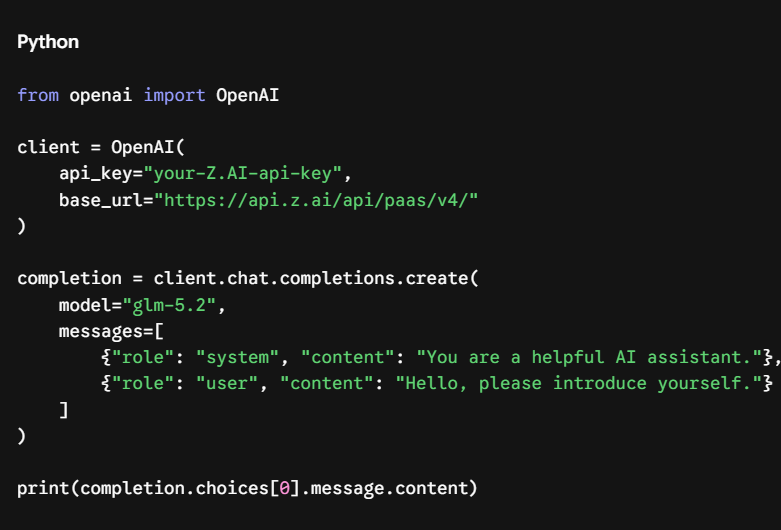
- Base URL: [https://api.z.ai/api/paas/v4/](https://api.z.ai/api/paas/v4/)
- Model ID: glm-5.2
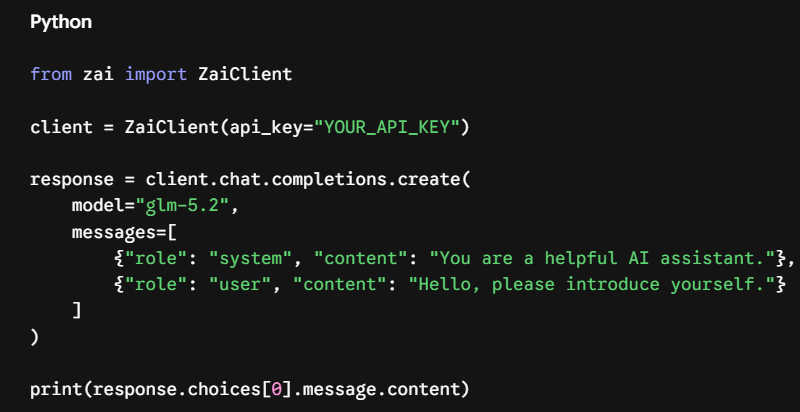
Z.ai natively supports five integration methods: a standard RESTful HTTP API, an official Python SDK (zai-sdk), a Java SDK (via Maven/Gradle), and full OpenAI SDK compatibility for both Python and Node.js. Because the endpoint strictly adheres to the OpenAI chat completions contract, any framework built around it, including LangChain, LlamaIndex, and most agent harnesses, works out of the box simply by changing the base_url, API key, and model name.
OpenAI Python SDK Example
Official Z.ai Python SDK Example
Official Pricing Breakdown
Z.ai’s listed rates for GLM-5.2 remain consistent across their documentation and independent pricing aggregators:
Three critical nuances define this pricing structure:
- Reasoning tokens cost the same as output. There is no separate surcharge for the model's internal "thinking." However, a highly verbose reasoning trace at the "Max" effort setting directly inflates your total output token count, increasing both latency and your final bill.
- Cached input is the ultimate cost lever. At roughly one-fifth the rate of fresh input, prompt caching is vital for agentic loops that repeatedly send massive system prompts or codebase contexts.
- Massive discount vs. Frontier Models. At $4.40 per 1M output tokens, GLM-5.2 is roughly five to six times cheaper than comparable closed models like Claude 3.5 Sonnet ($15/1M) or Claude 3 Opus ($25/1M).
(Note: Z.ai also offers flat-rate "GLM Coding Plans" starting around $18/month for single-developer IDE assistant usage. However, for production applications, SDK integrations, or multi-user agentic systems, the metered API is the necessary route.)
Decoding "Sub-500ms Latency"
When evaluating a reasoning model like GLM-5.2, "latency" is not a single number. Conflating the following three metrics is the most common mistake when judging if an API "feels fast":
- TTFT (Time to First Token): How long before any token begins streaming back, including invisible internal reasoning tokens.
- TTFAT (Time to First Answer Token): How long before the model's visible answer begins, after it finishes its internal reasoning trace. For human users, this dictates whether an app feels responsive.
- End-to-End Latency: The total time required to generate the complete response (prefill + reasoning + final output).
Where the Time Actually Goes
Independent benchmarking by Artificial Analysis provides a clear picture of GLM-5.2 operating at its default "Max" reasoning setting. They recorded an average TTFAT of 7.9 seconds.
Crucially, 7.1 of those seconds were spent generating reasoning tokens, while only ~0.8 seconds were spent on actual input prefill. At maximum reasoning effort, the bottleneck isn't the infrastructure; it is the model's own thought process.
Hitting the Sub-500ms Mark
That same inference provider reported bringing raw TTFT down to roughly 800ms through heavy infrastructure optimisation, combining:
- NVFP4 quantisation on NVIDIA Blackwell GPUs
- KV-aware request routing
- Prefill/decode disaggregation
- Multi-token-prediction (MTP) speculative decoding
To push meaningfully under that 800ms floor and hit true sub-500ms response times, you must combine that top-tier serving stack with strict request-level configuration. You need a cached prompt prefix (slashing prefill time) combined with reasoning disabled (eliminating the 7-second thought trace delay). Only then do sub-500ms API calls become a reality.
The reasoning_effort Parameter: Your Main Latency Lever
Per Z.ai's official documentation, GLM-5.2 exposes a reasoning_effort parameter that controls the depth of its internal thought process. This is not a minor tuning knob; it is the primary determinant of whether a given call comes back in under a second or takes several seconds.
- Default (Max Effort): If reasoning_effort is unset or set to anything other than "high", the model runs at Max effort. It generates a lengthy, sequential reasoning trace before the visible response begins.
- High Effort: Setting reasoning_effort="high" triggers a lighter reasoning pass, trading some depth for speed.
- Disabled Thinking: Setting enable_thinking=false disables the reasoning trace entirely, bypassing the thought process for tasks that do not need multi-step deliberation.
Z.ai advises using Max effort for complex, multi-step tasks, repo-scale refactors, long-horizon agentic runs, and hard reasoning problems. Reserve High or disabled thinking for latency-sensitive, simpler requests.
Practical rule of thumb: Default to High or disabled thinking for anything interactive. Reserve Max for background or asynchronous agentic workloads where a user isn't watching a loading spinner.
Making a Low-Latency Request
Combining the official endpoint, a lighter reasoning setting, and streaming (so the client renders tokens as they arrive) looks like this:
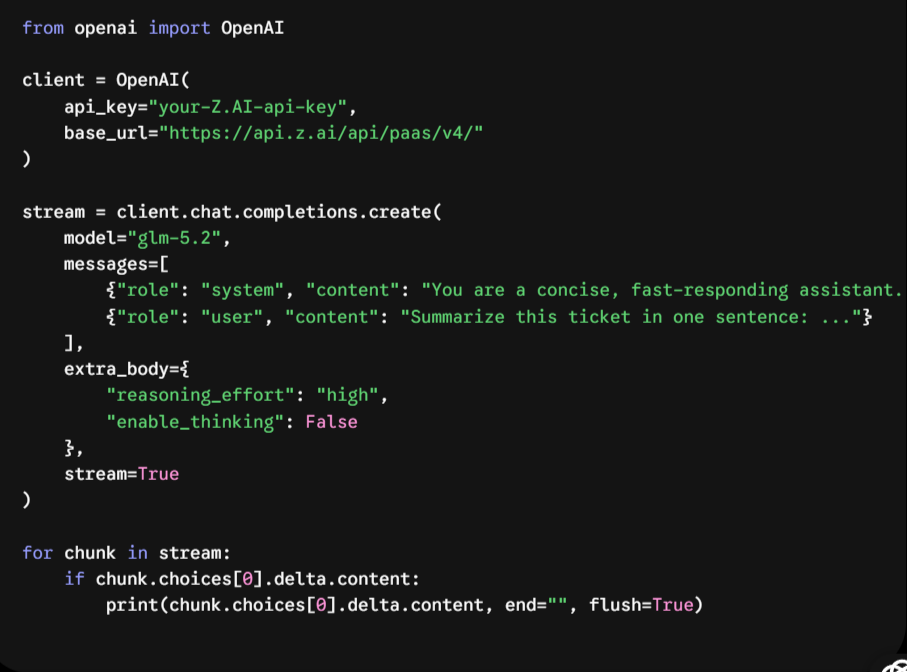
Two crucial implementation notes:
- Streaming reduces perceived latency, not actual latency. The first token still takes just as long to arrive, but your UI can start rendering immediately instead of waiting for the complete response.
- enable_thinking=false is a targeted tool. It is the strongest lever for genuinely short interactive turns like classification, short summarisation, or simple extraction. For anything requiring actual reasoning, disabling thinking will degrade output quality. Apply it selectively, not globally.
Prompt Caching: The Cost and Latency Multiplier
Because GLM-5.2 bills cached input at roughly a fifth of the fresh rate, prompt caching pulls double duty: it slashes costs and bypasses redundant prefill computation to lower TTFT. This is disproportionately important for GLM-5.2's massive 1M-token context. An agent that re-sends a large, static system prompt or codebase snapshot pays the full prefill cost every single time unless caching is active.
The practical pattern for latency-sensitive applications:
- Front-load stable content: Keep system instructions, reference documents, and tool schemas at the start of the prompt. Put request-specific, changing content at the end. Caching schemes match on a shared prefix, so anything after the first point of divergence will not benefit.
- Do not touch the history: For long-running agent sessions, avoid re-ordering or lightly editing earlier context between turns. This breaks the prefix match and forces a slow, uncached prefill on the next call.
- Reuse session objects: Structure multi-step agent loops to reuse the same session context across calls rather than reconstructing the prompt from scratch each time.
Provider Latency Landscape
Because GLM-5.2 is open-source and MIT-licensed, it is available directly through Z.ai and via more than a dozen third-party inference providers. The figures below are sourced from published, methodology-disclosed benchmarks (like Artificial Analysis) and reflect the standard Max-reasoning configuration unless otherwise noted.
Caveat: TTFT figures that do not specify reasoning effort typically include the full reasoning trace. Some published numbers run into several seconds because they measure TTFAT-equivalent behaviour at Max effort, not raw infrastructure latency. Treat any specific figure as a snapshot, and re-benchmark against your own workload.
Choosing Your Access Path
You have four main paths to call GLM-5.2, each offering a different balance of latency, cost, and control:
- Z.ai First-Party API: The official source with the lowest list price. It is the best starting point for prototyping and for workloads where canonical pricing and official documentation matter most.
- AI Gateways (e.g., OpenRouter): One OpenAI-compatible endpoint that routes to multiple underlying providers. Useful for automatic failover and routing based on speed or cost, without juggling multiple API keys.
- Specialised Inference Providers: Platforms like Baseten, Together AI, or DeepInfra run highly optimised serving stacks on top of the open weights. This is where the lowest published TTFT numbers currently originate.
- Self-Hosting / BYOC: Since there are no regional or revenue restrictions, running the weights yourself (or via a BYOC platform like Simplismart) gives you ultimate control and data privacy, though it requires significant GPU infrastructure.
Practical Latency Checklist
Before assuming GLM-5.2 "is slow" or "is fast," verify each of these independently in your implementation:
- [ ] Is reasoning_effort set explicitly, or is it silently defaulting to max?
- [ ] Does the task actually need reasoning at all, or would enable_thinking=false suffice for this specific turn?
- [ ] Is the prompt structured for caching, with static system instructions and context at the very front to hit the prefix cache?
- [ ] Is your client rendering via streaming, ensuring users see tokens as they arrive rather than waiting for the entire generation loop to finish?
- [ ] Are you measuring TTFT vs. TTFAT correctly, and accurately reporting the difference between "infrastructure delay" (TTFT) and "model thinking time" (TTFAT) to your stakeholders?
- [ ] Have you benchmarked multiple providers against your actual prompt length and reasoning-effort settings, rather than relying on a single published marketing number?
Conclusion
GLM-5.2 bridges the gap between frontier-level reasoning and open-weight accessibility. Its 744-billion-parameter scale and 1-million-token context window make it a formidable engine for agentic workflows, complex coding, and massive document synthesis.
However, brute-forcing a model of this size will always yield high latency. Achieving responsive, sub-second performance requires treating the API not as a black box, but as a system to be explicitly tuned. By aggressively structuring your prompts for caching, selectively disabling the internal reasoning engine for simpler tasks, and routing traffic through an optimised serving stack, whether via a specialised API provider or an enterprise BYOC platform, you can harness GLM-5.2's massive capabilities at speeds and costs that make production deployment genuinely viable.
Frequently Asked Questions (FAQ)
What is the difference between TTFT and TTFAT?
TTFT (Time to First Token) measures how quickly the API returns any token, which includes invisible internal reasoning tokens. TTFAT (Time to First Answer Token) measures when the actual, visible response begins after the model has finished thinking. If reasoning is enabled, the gap between TTFT and TTFAT can span several seconds.
How do I disable reasoning to speed up my API calls?
You can bypass the model's internal thought process by passing "enable_thinking": False inside the extra_body payload of your API request. This is the single most effective way to drop latency for simple, interactive queries that don't require complex logic.
How big is the context window, and does it cost more?
GLM-5.2 supports a massive 1-million-token context window. Z.ai does not charge a "long-context surcharge"; whether you send 500 tokens or 950,000 tokens, the rate remains a flat $1.40 per 1M fresh input tokens (and only $0.26 if cached).
Do I need my own GPUs to use GLM-5.2?
No. Because the FP8 model weights require over 700GB of VRAM (mandating an 8-GPU node like an HGX B200), most developers use the hosted Z.ai API or a third-party inference provider. If you require strict data privacy, platforms like Simplismart allow you to deploy the model in your own cloud VPC (BYOC) without managing the hardware orchestration yourself.
How does prompt caching work with this API?
The API automatically caches prompts based on the exact sequence of tokens starting from the beginning. By placing your static system instructions and massive context documents at the very front of the prompt, and only changing the user's latest query at the very end, you trigger a cache hit. This reduces the input cost to $0.26/1M tokens and completely bypasses prefill latency.
What is the difference between "Max" and "High" reasoning effort?
"Max" is the default setting that instructs the model to reason at its deepest, most comprehensive level, which maximises response quality but maximises latency. "High" triggers a lighter reasoning pass that intentionally trades away a small amount of analytical depth to deliver faster response times.
Are internal reasoning tokens billed separately?
No, there is no separate surcharge for the model's internal "thinking" time. Reasoning tokens are billed at the standard output token rate of $4.40 per 1M tokens. However, because a deep reasoning trace increases the overall number of generated tokens, it directly inflates the final cost of the API call.
Can I use the official OpenAI SDK to call GLM-5.2?
Yes, the Z.ai API endpoint strictly adheres to the OpenAI chat completions contract. You can use your existing OpenAI client initialisation by simply replacing the base_url with [https://api.z.ai/api/paas/v4/](https://api.z.ai/api/paas/v4/), using your Z.ai API key, and specifying model="glm-5.2".
What architectural innovation makes the 1M token context efficient?
GLM-5.2 introduces a technique called IndexShare. Instead of calculating the per-layer attention indexer at every single layer (which scales quadratically), IndexShare recomputes this indexer only once every four sparse layers, cutting the per-token computational load by 2.9x at full context length.
Does Z.ai offer any flat-rate billing options?
Yes. For developers looking to use the model as an IDE assistant inside tools like Claude Code, Z.ai offers a flat-rate "GLM Coding Plan" starting around $18/month. However, for programmatic application backends, multi-step agent loops, or multi-user systems, the metered pay-as-you-go API is the correct access path.
Want to run GLM-5.2 at sub-500ms latency without vendor lock-in? Don't compromise between the high costs of self-hosting and the data privacy risks of shared public APIs. With Simplismart, you can deploy the open-weights GLM-5.2 checkpoint directly into your own cloud infrastructure (BYOC) using our highly optimized inference engine. Achieve blazing-fast token throughput and automatic scaling while keeping 100% control of your data. Deploy GLM-5.2 with Simplismart