
Key Takeaways:
- What is Gemma 4? A family of highly capable, open-weight models (built on Gemini 3 research). It features a massive 256K token context window, advanced reasoning ("thinking modes"), and multimodal capabilities (handling text, images, and audio natively).
- The API Advantage: You can access the 31B Dense and 26B MoE (Mixture-of-Experts) models via the Gemini API. It costs nothing in tokens (free tier), requiring only an API key.
- Zero Infrastructure: Calling the API means Google manages the GPUs and compute. You just send HTTP requests using Python, JavaScript, or cURL without provisioning hardware, handling CUDA drivers, or managing VRAM.
- Seamless Scaling: If you outgrow the free API, you can seamlessly migrate the exact same model to Google Cloud (Vertex AI, Cloud Run serverless GPUs, or GKE) for strict SLAs and private networking, or you can self-host it using tools like Ollama or Hugging Face.
- On-Device Future: Gemma 4 is the foundation for the upcoming Gemini Nano, meaning the API code you write today will easily translate to on-device Android applications later this year.
On March 31, 2026, Google DeepMind launched Gemma 4, the latest generation of its open-weight model family, built on the same advanced research architecture that powers the Gemini 3 series.
While Gemma 4 introduces massive capability upgrades, including native text, audio, and image inputs alongside a massive 256K token context window, the biggest news for developers is how you can access it. Google now offers Gemma 4 as a hosted API through the Gemini API. This means you can leverage the flexibility and customisation of a state-of-the-art open model without the headache of provisioning, patching, or paying for dedicated GPUs.
In this comprehensive guide, we rely exclusively on Google’s official documentation and engineering blogs to break down everything you need to know, including:
- What is Gemma 4? A deep dive into its multimodal capabilities and Gemini 3 architecture.
- How the Hosted API Works: Getting started and integrating the endpoint into your applications.
- API Pricing Breakdown: What you can expect to pay compared to traditional cloud compute.
- Hosted API vs. Self-Hosting: Which deployment strategy makes the most sense for your workload.
What Is Gemma 4? A Deep Dive into Google's Open Models
Gemma is a family of highly capable, open-weight models developed by Google DeepMind. The Gemma 4 generation introduces powerful multimodal capabilities, natively processing text and image inputs to generate text outputs (with audio supported on select models). Released in both pre-trained and instruction-tuned variants, Gemma 4 boasts a massive context window of up to 256K tokens while maintaining robust multilingual support across more than 140 languages.
Built with both Dense and Mixture-of-Experts (MoE) architectures, Gemma 4 is optimised for complex tasks like text generation, coding, and logical reasoning. The models are available in five strategic sizes: E2B, E4B, 12B, 26B A4B, and 31B, making them incredibly versatile. Developers can deploy Gemma 4 anywhere, from high-end mobile phones and laptops to enterprise servers, effectively democratizing access to state-of-the-art AI.
Two links used: the DeepMind Gemma page for the opening attribution, and the official model card for the specs/sizes claim. (Also corrected "26 B, A4B" to "26B A4B" — it's one model name, not two separate sizes, so the original list read as six items instead of five.)
Key Architectural Advances
According to Google’s official model card, Gemma 4 brings several groundbreaking upgrades to the open-model ecosystem:
- Advanced Reasoning: All models function as highly capable reasoners, featuring configurable thinking modes for complex problem-solving.
- Extended Multimodalities: Every model processes text, video, and images (with variable aspect ratio and resolution support). Native audio processing is featured exclusively on the E2B, E4B, and 12B models.
- Diverse & Efficient Architectures: Developers can choose between Dense and MoE variants tailored for scalable, environment-specific deployments.
- Massive Context Windows: Small models support a 128K context window, while medium-sized models push the boundary to 256K tokens.
- Agentic & Coding Capabilities: Gemma 4 achieves significant improvements in coding benchmarks and introduces native function-calling support to power autonomous AI agents.
- Native System Prompts: New system role support allows developers to dictate structured, highly controllable model behaviour.
To power these features efficiently, Google DeepMind innovated the model's underlying attention design:
The models employ a hybrid attention mechanism that interleaves local sliding window attention with full global attention, ensuring the final layer is always global. This hybrid design delivers the processing speed and low memory footprint of a lightweight model without sacrificing the deep awareness required for complex, long-context tasks.
Gemma 4 Model Sizes and Specifications
Understanding the Naming Conventions:
- The "E" (E2B, E4B): Stands for "effective" parameters. These smaller, mobile-friendly models utilise Per-Layer Embeddings (PLE) to maximise parameter efficiency for on-device deployment.
- The "Unified" (12B): Refers to a breakthrough encoder-free architecture. The 12B model eliminates traditional encoders, projecting raw image patches and audio waveforms directly into the LLM's embedding space via lightweight linear layers.
- The "A" (26B A4B): Stands for "active parameters." While the MoE model contains 26B total parameters, it only activates a 4B subset during inference. This allows it to run significantly faster than a standard 26B model while maintaining high performance.
Benchmark Performance
Gemma 4 is highly competitive. Based on Google's internal instruction-tuned evaluations, the flagship Gemma 4 31B model achieved:
- 85.2% on MMLU Pro
- 89.2% on AIME 2026 (no tools)
- 80.0% on LiveCodeBench v6
Official Release Timeline
Straight from Google's official releases page, here is how the Gemma 4 rollout occurred:
- March 31, 2026: Initial launch of Gemma 4 in E2B, E4B, 31B, and 26B A4B sizes.
- April 16, 2026: Release of Gemma 4 - MTP variants for E2B, E4B, 31B, and 26B A4B.
- June 3, 2026: Release of the groundbreaking Gemma 4 12B Unified model.
Running Gemma 4 via the Gemini API
Normally, leveraging an open-weight model requires downloading multi-gigabyte files and managing your own GPU infrastructure. Google completely bypasses that hurdle with a hosted option. According to the official developer documentation:
The Gemini API provides hosted access to Gemma as a programming API you can use in application development or prototyping. This API is a convenient alternative to setting up your own local instance of Gemma and a web service to handle generative AI tasks.
In short: Google provisions and runs the GPUs; you simply send HTTP requests.
Supported Gemma 4 Models
Currently, the Gemini API supports hosted inference for the following instruction-tuned models:
- gemma-4-31b-it
- gemma-4-26b-a4b-it
Getting Your API Key
To authenticate your requests, you need a Gemini API key. You can generate one instantly for free via the Google AI Studio application at [aistudio.google.com/apikey](https://aistudio.google.com/apikey).
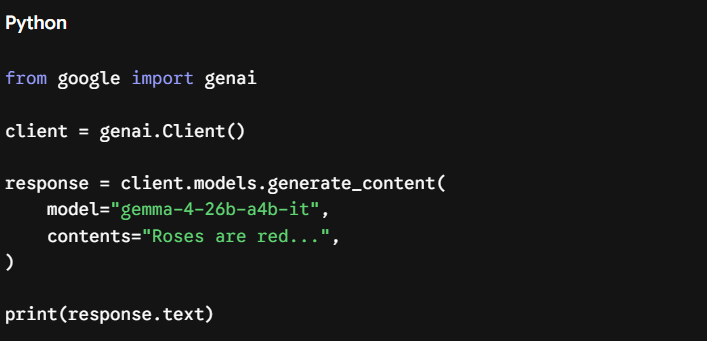
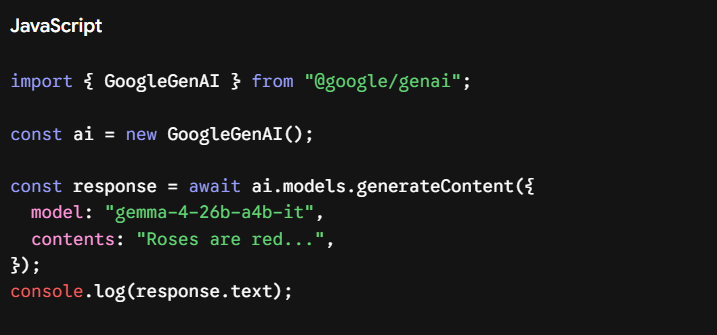
Quickstart: Basic API Requests
You don't need Docker containers, CUDA drivers, or VRAM budgeting to interact with Gemma 4. Below are minimal examples of how to generate content using the official SDKs.
Core Capabilities of the Hosted API
The hosted endpoint unlocks most of Gemma 4's powerful native features directly through the API.
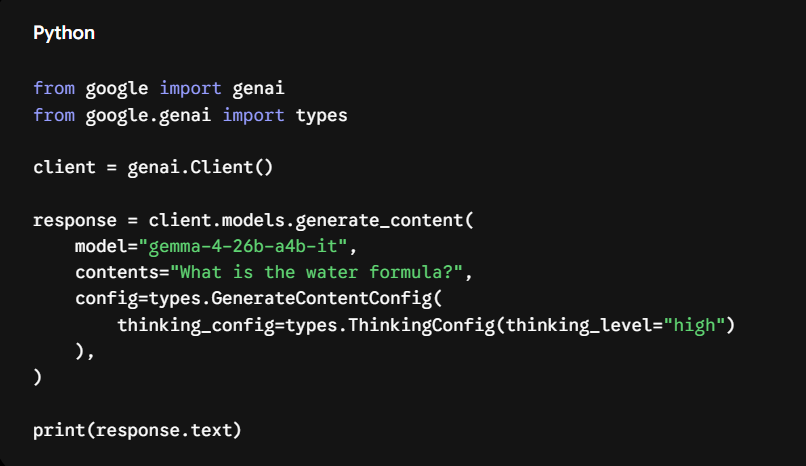
Configurable Thinking Mode
Gemma 4 utilises an internal thinking process to optimise multi-step reasoning, dramatically improving performance on algorithmic coding and advanced mathematical proofs. You can enable this multi-step logic in the API by setting the thinking_level to "high".
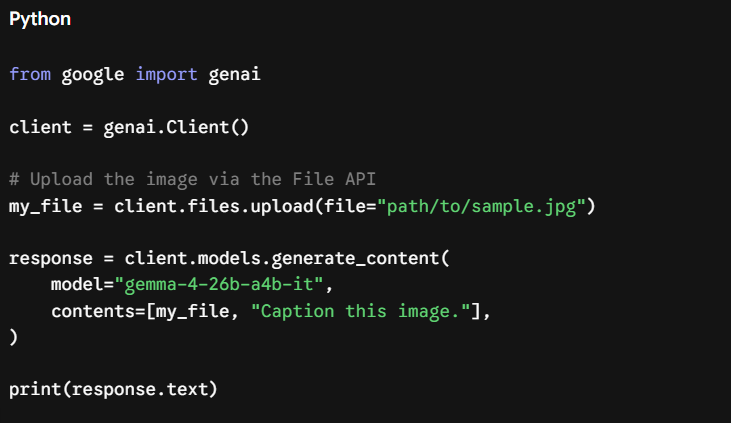
Multimodal Image Understanding
Gemma 4 natively processes images, unlocking frontier-level developer use cases that previously required specialised, domain-specific vision models.
Function Calling and Search Grounding
Beyond generating text, Gemma 4 supports structured tool use (Function Calling). Through the same API surface, developers can build autonomous agents that execute external APIs or ground their responses in live web results using Google Search.
API Pricing and Data Policies
This is where the Gemma 4 API stands out compared to Google's proprietary Gemini models. According to the official Gemini Developer API pricing page, querying Gemma 4 is highly accessible:
Enterprise Deployment Options on Google Cloud
If your workload outgrows Google AI Studio’s free hosted endpoint, requiring enterprise SLAs, private networking, or dedicated throughput, Google Cloud provides several managed infrastructure paths for Gemma 4:
- Vertex AI: Deploy Gemma 4 directly to your own Vertex AI endpoints via the Model Garden. You maintain complete control over serving infrastructure and costs while ensuring data remains strictly within your Google Cloud perimeter. Additionally, the Gemma 4 26B MoE model is available as a fully managed, serverless option.
- Cloud Run (Serverless GPUs): Run demanding Gemma 4 inference workloads using serverless GPUs backed by NVIDIA RTX PRO 6000 (Blackwell) hardware with 96GB of vGPU memory. Cloud Run automatically manages the infrastructure, scaling to zero when inactive so you only pay for active inference compute.
- Google Kubernetes Engine (GKE): For high-throughput and memory-efficient LLM serving, teams requiring fine-grained control can serve Gemma 4 on GKE powered by vLLM.
- Cloud TPUs: Gemma 4 is fully optimised to run on Google Cloud TPUs across GKE, Compute Engine (GCE), and Vertex AI.
- Sovereign Cloud: Designed for highly regulated enterprise or government workloads, Gemma 4 is available across Google Sovereign Cloud offerings, including Data Boundary, Google Cloud Dedicated (such as S3NS in France), and air-gapped Google Distributed Cloud deployments.
On-Device AI: Gemma 4 Powers Next-Gen Gemini Nano
Gemma 4 isn't just a cloud model. According to the Android Developers Blog, Gemma 4 serves as the foundational architecture for the next generation of on-device AI: Google positions the release as bringing its most capable models directly onto Android hardware, describing Gemma 4 as the base for the next generation of Gemini Nano, meaning code built against Gemma 4 today is designed to carry over automatically once Gemini Nano 4-enabled devices ship later this year.
This cross-compatibility allows developers to prototype applications using the hosted API today and seamlessly deploy the same logic on-device via Android AICore for private, low-latency, offline inference later.
Hosted Gemini API vs. Self-Hosting
If speed-to-market and zero operational overhead are your top priorities, the hosted Gemini API offers the fastest development path. If you require absolute data locality, offline execution, or smaller/specialized parameter sizes, local frameworks like Ollama, Hugging Face, LM Studio, llama.cpp, or MLX provide full flexibility.
Developer Quick-Start Checklist
- Get Your API Key: Generate a free key via Google AI Studio.
- Install the SDK: Run pip install google-genai (Python) or npm install @google/genai (JavaScript).
- Initialise the Model: Point your client to gemma-4-26b-a4b-it or gemma-4-31b-it.
- Enable Advanced Reasoning: Set thinking_level="high" for complex logic, math, or coding tasks.
- Scale to Production: Seamlessly migrate your implementation to Vertex AI, Cloud Run, or GKE when enterprise SLAs or private networks are required.
Conclusion
The release of the Gemma 4 API marks a significant shift in how developers access and deploy open-weight AI models. By hosting Gemma 4 directly within the Gemini API ecosystem, Google DeepMind removes the friction of managing complex CUDA drivers, provisioning expensive GPUs, and building custom serving stacks.
Whether you are building low-latency AI agents with function calling, processing high-resolution multimodal data, or leveraging deep-reasoning thinking modes, the hosted Gemma 4 endpoint allows you to move from prototype to production in minutes. Furthermore, the seamless path from Google AI Studio's free hosted tier to enterprise Google Cloud infrastructure (Vertex AI, Cloud Run, GKE) ensures that your application can scale effortlessly without changing your underlying model architecture.
Frequently Asked Questions (FAQ)
Is the Gemma 4 API completely free to use?
Yes. Google offers hosted access to select Gemma 4 models through Google AI Studio free of charge. You only need a valid Gemini API key to start making calls. Note that under the free tier, input and output data may be processed to improve Google products in accordance with standard Gemini API terms.
Which Gemma 4 models are available on the hosted Gemini API?
Currently, the Gemini API supports hosted inference for the instruction-tuned gemma-4-31b-it (31B Dense model) and gemma-4-26b-a4b-it (26B Mixture-of-Experts model).
How do I access Gemma 4 if I need complete data privacy or offline capabilities?
If your application requires strict data locality or air-gapped security, you can self-host any of the five official Gemma 4 model sizes (E2B, E4B, 12B Unified, 26B A4B, 31B) using local frameworks such as Ollama, Hugging Face, vLLM, or LM Studio. For enterprise cloud environments, you can deploy Gemma 4 within your private perimeter via Vertex AI or Google Distributed Cloud.
What is the difference between Gemma 4 and Gemini 3?
Gemini 3 is Google’s primary family of proprietary, closed-source models delivered as a service. Gemma 4 is Google’s open-weight model family, meaning the model weights are publicly available for download, fine-tuning, and self-hosting. However, Gemma 4 is built using the same underlying research and architectural innovations as Gemini 3.
Can I deploy Gemma 4 models directly on mobile devices?
Yes. The smaller Gemma 4 variants (such as E2B and E4B) are optimised with Per-Layer Embeddings (PLE) for efficient on-device execution. Additionally, Gemma 4 serves as the foundation for the next generation of Gemini Nano, allowing code written for Gemma 4 to run on compatible Android devices via Android AICore.
How does "Thinking Mode" work in the Gemma 4 API?
Gemma 4 features configurable reasoning capabilities that allow the model to spend additional processing cycles on complex logic, algorithmic coding, and math problems before generating an answer. You can activate this via the SDK by passing thinking_level="high" in your configuration settings.
Deploy Gemma 4 Today on Simplismart → Skip the infrastructure setup entirely. Run Google’s Gemma 4 31B and 26B MoE models at production scale with up to 149 tokens/second, no provisioning required. Start building on Simplismart's high-performance inference engine.